Choose screen media
Polyurethane Screen Panel Hardness: A Shore A Selection Guide
Polyurethane screen hardness is usually specified on the Shore A scale, but the number is only an indentation reading. Softer grades can flex and release near-size particles; harder grades can support shape and tear resistance in some formulations. Neither choice guarantees longer wear. Select hardness with feed impact, abrasion mode, aperture, panel thickness, temperature, water exposure and polyether or polyester chemistry, then verify performance on the actual deck.
Key points
- Shore A measures indentation resistance, not total material quality.
- Harder polyurethane is not automatically more abrasion resistant.
- Wet or warm-water duty requires a hydrolysis review.
- Color is not a transferable hardness or formulation code.
- Record the current failure mode before changing grade.
What Shore A tells you—and what it does not
Shore hardness is measured by pressing a standardized durometer indenter into an elastomer and reading its resistance to indentation. Shore A is commonly used for softer polymers, while Shore D is used for harder materials. For screen media, always write the scale with the value. A bare number can be misread or compared with a different test scale.
The reading does not directly report abrasion loss, tear strength, rebound, tensile strength, hydrolysis resistance or fatigue life. Those properties depend on the complete formulation and cure, not just durometer. Research on polyurethane elastomers has found significantly different abrasion resistance among materials with the same hardness. That makes hardness a useful specification field, but a poor stand-alone purchasing rule.
Test method and sample condition also matter. A thin perforated rib, a thick solid border and a laboratory test piece do not respond identically to an indenter. For a replacement, request the stated Shore A value and tolerance together with the formulation family and relevant property data. Compare like with like rather than testing a worn, weathered panel and treating that reading as its original grade.
Hardness direction by screening duty
Published screen-media examples span a wide range. One mining-material guide uses 70 Shore A for an upper-deck screen and 85 or 90 Shore A for a lower-deck screen. Another screen catalogue lists perforated-area grades of 35, 45, 65 and 85 Shore A, with softer grades used to help release near-size particles. These are evidence that duty changes the choice, not universal set points.
Use the table to decide which direction to investigate. Keep aperture, thickness, support and chemistry in the review. A change in hardness that solves one problem can introduce another.
| Observed duty or problem | Hardness direction to review | What must also be checked |
|---|---|---|
| Near-size pegging with no structural distortion | Softer or more flexible working face | Aperture taper, slot direction, deck motion and web thickness |
| Edges roll, holes stretch or the face cannot hold shape | Harder or better-supported construction | Panel span, reinforcement, build height and fasteners |
| Sharp feed initiates cuts that grow into tears | Higher tear and cut resistance; hardness may rise | Compound data, feed impact, thickness and impact-zone layout |
| Sliding abrasion removes the face evenly | Do not choose by hardness alone | Abrasion test method, compound family, particle shape and velocity |
| Wet or warm wash duty causes softening or cracking | Review chemistry before durometer | Polyether versus polyester, temperature, pH and exposure time |
| High impact at the feed end | More energy absorption or a layered design | Blank impact zone, support, drop height and load distribution |
Why harder does not always mean longer life
Hardness can correlate with some mechanical properties inside one controlled formulation series, but the relationships are not universal. Published screen-polyurethane data show tear strength increasing as Shore A rises, while resilience falls. In the same data, abrasive loss does not improve steadily with increasing hardness. A separate polymer study reports that lower-hardness materials can sometimes resist abrasive wear better and that equal-hardness formulations can wear very differently.
This is practical on a deck. A hard panel may resist deformation yet transmit more impact and flex less around trapped near-size particles. A softer panel may release pegged material and absorb energy, yet sag or distort if its span and reinforcement are unsuitable. Cut growth, sliding abrasion, particle erosion and cyclic flexing are different damage mechanisms. One durometer change cannot optimize all of them. The blinding and pegging guide helps separate aperture blockage from material failure.
When comparing compounds, request test values produced under the same method. More importantly, inspect the used panel. A polished face suggests a different mechanism from torn aperture corners, cracked ribs, enlarged holes, broken reinforcement or hydrolysis-related surface breakdown. Diagnose the mechanism before deciding which property needs to change.
- Uniform face loss: compare abrasion behavior and feed travel.
- Cuts from sharp particles: compare tear and cut-growth behavior.
- Cracked flex zones: review fatigue, resilience and support.
- Stretched openings: review stiffness, span and reinforcement.
- Pegged apertures: review flexibility, aperture geometry and motion.
Polyether versus polyester in wet duty
Polyurethane is a family of materials. Two panels with the same Shore A reading can use different soft-segment chemistry and behave differently in water, heat and abrasion. Polyester-based polyurethane can offer strong mechanical and abrasion properties, but long exposure to hot water, moisture vapor or tropical conditions can break polyester chains through hydrolysis. Polyether-based polyurethane is generally much more resistant to hydrolytic degradation.
That does not make every polyether formulation correct for every wet screen. Water temperature, pH, dissolved chemicals, microbes, residence time and shutdown storage all influence exposure. Ask for the formulation family and its suitability for the actual slurry. A generic statement that the panel is polyurethane is insufficient for a dewatering or wash circuit.
For continuously wet work, the polyurethane dewatering panel selection should therefore record chemistry as well as slot and hardness. For dry abrasive sizing, a polyester formulation may remain a valid candidate if its other properties match the duty. Where the service alternates between wet operation and hot idle periods, describe both states because hydrolysis risk can increase with temperature.
Worked selection example: upper deck versus lower deck
Consider a plant replacing two panel groups. The upper deck receives coarse feed and shows cuts near the impact zone, while the lower deck handles finer wet material and shows uniform face wear plus occasional pegging. Published material guidance gives 70 Shore A as one upper-deck example and 85 or 90 Shore A as lower-deck examples, but copying those values without diagnosis would be a mistake.
For the upper deck, first reduce concentrated impact with deck layout and support. A blank PU impact panel is a more direct control at the feed point than merely increasing durometer. Then compare tear resistance and resilience of candidate compounds. A layered construction may use a softer working layer and a firmer supporting layer; published examples confirm that different layers can legitimately use different hardnesses.
For the lower deck, confirm that the wear is sliding abrasion rather than chemical breakdown. Because it is wet, review polyether versus polyester and operating temperature. Then trial a hardness that keeps the aperture stable without worsening pegging. The correct comparison holds aperture, panel thickness, fixing and deck position constant and records tonnes processed, cut performance, pegging and measured wear location.
Decision rule: change one controlled variable at a time. If both compound chemistry and hardness change together, the trial cannot show which change produced the result. Label every test panel and map its exact position before startup.
Panel design can matter more than a small hardness change
Aperture width, slot length, web thickness, panel thickness, reinforcement and unsupported span determine how much the screening face flexes. A thin flip-flow polyurethane mat is intended to move differently from a thick modular polyurethane panel, even if their durometer readings overlap. Do not transfer a hardness choice between those constructions without reviewing the motion and support.
Thicker webs and panels can improve structural life but reduce active open area or change how near-size particles enter the aperture. A softer compound in a well-supported panel may hold geometry better than a harder compound over an excessive span. Likewise, a hard panel with poor rail contact can rock, fret and crack at the fixing points.
Dual-hardness and layered designs separate duties: the working face can emphasize flexibility or wear behavior while the supporting layer carries load. Ask where each hardness is located and how much material remains above reinforcement. A single reported value cannot describe a layered panel.
Specify and verify the grade
Do not use color as the grade specification. Natural polyurethane can vary from light tan to darker amber, and pigments can make any supplier-specific color scheme look consistent without making it transferable. Technical guidance notes that natural color variation can occur without changing chemical or physical properties. Record the compound identifier, Shore scale, target and tolerance, chemistry, test method and drawing revision.
For a trial, install labelled panels in comparable positions. Record feed, water, temperature, deck location, aperture, thickness and starting mass or measured reference thickness where practical. At each inspection, photograph the same marked zones and note pegging, tears, hole growth, edge lift and support contact. Service hours alone are weak evidence if plant rate or feed changes. Use the modular panel measurement guide to keep geometry constant.
Before repeating an order, compare the observed failure mode with the original objective. A harder panel that lasts longer but reduces cut accuracy or open area may not improve the circuit. When the media family itself is uncertain, compare duties with the woven wire, polyurethane and rubber guide. The useful result is stable separation at an acceptable replacement interval, not the highest Shore A number.
| Specification field | Record |
|---|---|
| Hardness | Shore scale, target, tolerance and test method |
| Chemistry | Polyether, polyester or other identified formulation family |
| Construction | Single layer, layered, reinforced, modular, tensioned or flip-flow |
| Geometry | Aperture, web, panel thickness, footprint and fixing |
| Duty | Deck position, feed, water, temperature, impact and current failure |
| Trial acceptance | Separation, throughput, pegging, wear pattern and replacement interval |
Frequently asked questions
What Shore hardness is used for polyurethane screen panels?
There is no single standard value. Published examples range from soft anti-clogging grades to harder structural grades; one mining guide uses 70 Shore A for an upper deck and 85 or 90 Shore A for lower-deck examples. Treat these as application examples. Feed, formulation, geometry, water, temperature and failure mode determine the actual choice.
Is harder polyurethane always more wear resistant?
No. Hardness is indentation resistance, while wear can be sliding abrasion, particle erosion, cutting, tearing or fatigue. Research shows equal-hardness polyurethane formulations can have significantly different abrasion resistance. Compare relevant test data and used-panel damage, then run a controlled trial. A harder grade may hold shape better but can sacrifice flexibility or resilience.
What does Shore A measure?
Shore A measures how strongly an elastomer resists indentation by a specified durometer. It is useful for comparing properly tested materials on the same scale. It does not directly measure abrasion loss, tear strength, rebound, hydrolysis resistance or service life, so those properties need separate evidence when they control the screen failure.
Should wet screening use polyether or polyester polyurethane?
Polyether polyurethane is generally preferred when hydrolysis resistance is important because polyester chains can degrade during prolonged exposure to hot water or moisture. However, the whole formulation and actual water chemistry matter. Record temperature, pH, chemicals and exposure cycle, then confirm the selected compound is qualified for that wet service.
Does polyurethane color indicate hardness?
Not reliably. A manufacturer may use color as an internal identifier, but the same color can represent different grades elsewhere. Natural polyurethane also changes shade with raw materials, processing, age and ultraviolet exposure without necessarily changing its specified properties. Use a compound code and a Shore A value with tolerance, not color alone.
Can one screen deck use more than one polyurethane hardness?
Yes. Different deck zones can face different impact, abrasion and pegging conditions, and layered panels can use one hardness at the working face and another in the support layer. Map each grade by position and keep aperture, thickness and fixing clear. Controlled zoning is useful; unlabelled mixing makes performance difficult to diagnose.
Products mentioned
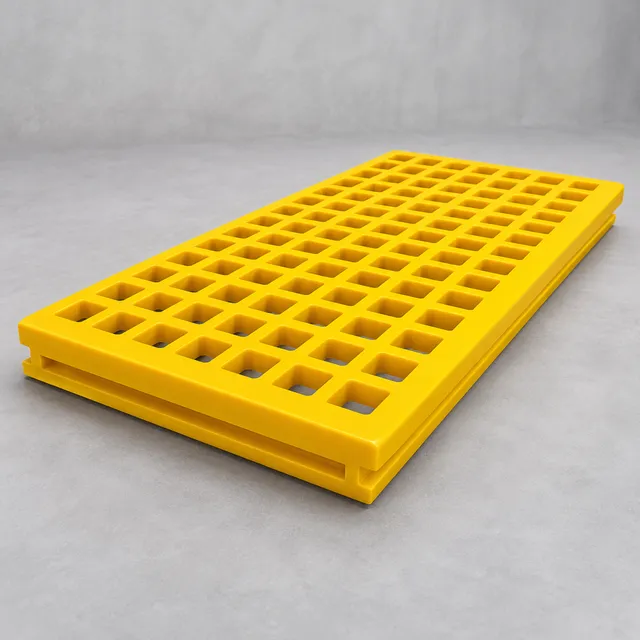
Modular Polyurethane Screen Panels
Moulded PU modules that replace one worn panel at a time.
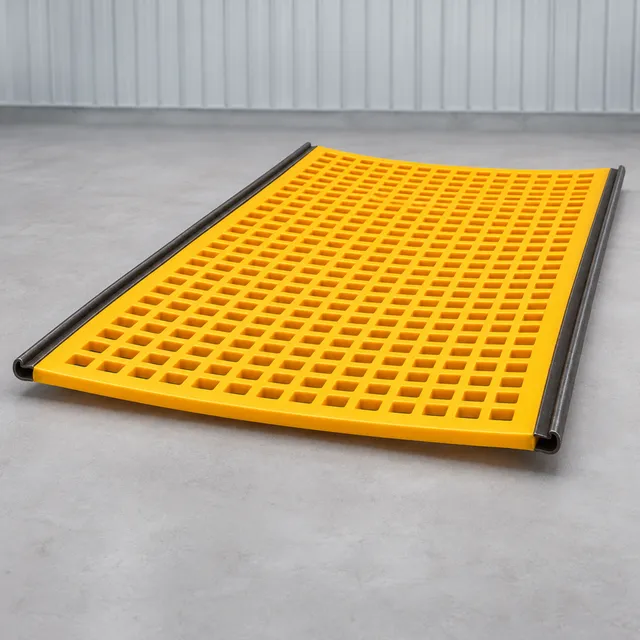
Tensioned Polyurethane Screen Mats
Rope-reinforced PU mats with steel hooks that fit cross- or side-tension decks.
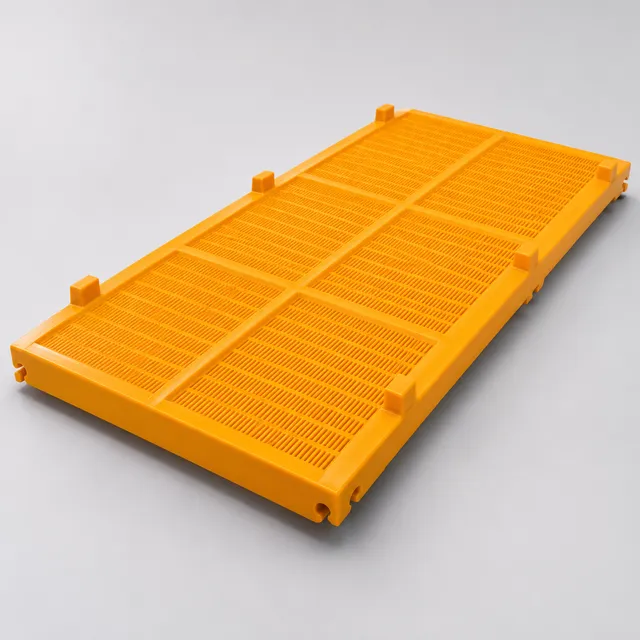
Polyurethane Dewatering Panels
Fine-slot PU panels for dewatering screens on sand, coal and mineral plants.
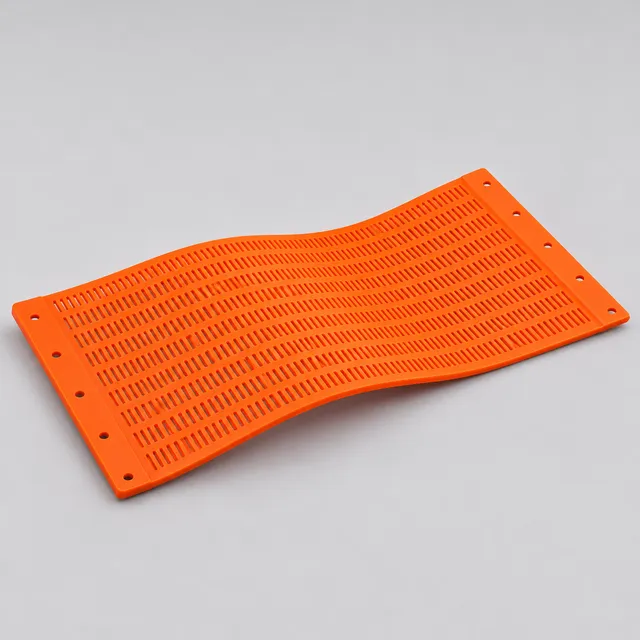
Flip-Flow Polyurethane Mats
Thin, flexible mats for flip-flow (trampoline) screens on wet and sticky fines.
Need a replacement screen?
Send the sizes and a photo of the old panel. We reply with a quotation or questions.
More guides
How to Measure Modular Polyurethane Screen Panels
Measure a modular polyurethane panel only after identifying its fixing system. Record the finished footprint, thickness and build height; then…
Choose screen mediaWoven Wire vs Polyurethane vs Rubber Screen Media
Choose woven wire when open area and sharp sizing matter most, polyurethane when wet or abrasive feed causes wear or blocking, and rubber where…
TroubleshootScreen Blinding vs Pegging: Causes and Fixes
Blinding is a coating of sticky fines that covers wires and closes many apertures; pegging is individual near-size or elongated particles wedged in…
References
- Intertek — Shore Hardness ASTM D2240
- Shore hardness test methods overview
- Cast polyurethane mining application guide
- Polyurethane screen mechanical properties
- Polyurethane abrasive wear research
- Polyether and polyester hydrolysis behavior
- Polyurethane screen hardness and clogging guidance
- Natural urethane color technical note