Choose screen media
Dewatering Screen Panels: Slot Size, Open Area and Choice
Choose dewatering screen panels from the feed grading, target solids recovery, required drainage and wear pattern—not slot size alone. Start with the existing proven aperture, confirm slot direction and fixing, then trial one controlled change. Polyurethane usually suits abrasive modular decks; wedge wire favors drainage area. Judge the result by discharged moisture, lost solids, capacity and panel life together.
Key points
- Treat the solids bed as part of the separation system.
- Compare slot width, open area and wear life together.
- Use different panel functions in feed, pool and discharge zones.
- Change one variable at a time and measure both streams.
- Diagnose wet product before choosing a wider slot.
How a dewatering deck actually removes water
A dewatering screen does more than pass water through holes. Wet feed reaches a steep feed section, drains quickly, and collects near the low point. Linear vibration then carries the solids up the main deck. A main deck near a five-degree uphill angle is documented in fine-coal test work, but the correct setting belongs to the machine design and duty. The discharge dam helps build a deep, stable bed.
That bed becomes a filter. Water and some very fine particles move through the lower layers and the panel, while the solids cake retains material smaller than the nominal opening. This is why aperture alone does not predict the recovered particle size. Feed grading, bed depth, vibration, liquid volume and residence time all influence the result. If the bed disappears, the same panel may lose more fines even though its slots have not changed.
Counter-rotating drives are commonly used to create linear motion. The required direction is uphill for the solids while drainage is downward. Confirm that the machine is moving correctly before blaming the media. A reversed drive, uneven feed or a low dam can produce a thin bed and wet discharge that no panel change will cure.
- Feed section: spread slurry and release free water.
- Pool section: establish an even solids bed.
- Uphill section: continue drainage while conveying solids.
- Discharge: retain enough bed without choking capacity.
Choose slot width from the job, not a universal chart
Published examples show how widely dewatering apertures vary. Industry training material lists panels from about 0.1 to 2 mm, while another technical sheet gives 0.2 to 0.3 mm as a common fine-duty range and notes openings as large as 5 mm for coarse material. These are reference ranges, not a selection rule. Your feed curve and acceptable loss to underflow matter more than a generic application label.
Begin with a representative wet particle-size distribution for the feed, oversize product and drainage stream. State the product requirement: maximum allowed moisture, minimum solids recovery, or both. If the present panel makes acceptable product but drains too slowly, first check blocked area, feed loading and bed control. A wider slot may improve water passage, but it can also increase valuable solids loss until the filter bed forms.
Long slots are often placed across the direction of travel in documented dewatering designs. The cross-flow arrangement exposes moving material to repeated narrow slot widths. Do not infer orientation from panel shape; mark material flow on the drawing and sample. For a replacement, confirm whether the slot runs across or with travel because two visually similar modules can behave differently.
| Question | Evidence to collect | Decision signal |
|---|---|---|
| Are we losing saleable fines? | Timed underflow sample plus particle-size test | Do not widen until the loss mechanism is known |
| Is drainage area restricted? | Photograph a washed panel and estimate blocked surface | Clean or correct spray and feed before changing aperture |
| Is the bed filtering correctly? | Record bed depth across the width | Stabilize distribution and dam setting |
| Has the slot worn open? | Measure slots at feed, center and discharge zones | Replace or rotate by wear pattern |
| Is a new slot justified? | Run a controlled trial and sample both streams | Accept only if moisture and recovery improve together |
Balance open area, wear and support
Open area limits the amount of water that can pass through clean media. More open area can raise drainage capacity, but only when the deck receives the flow evenly and the underscreen system can carry it away. Nominal open area is not the same as working open area. Blinded slots, support rails, blank borders, the solids bed and accumulated scale all reduce the surface that actually drains.
A polyurethane dewatering panel is a practical starting point for abrasive modular duties because individual worn zones can be changed. A fine-slot polyurethane panel can serve tighter separations where the panel design supplies sufficient drainage area. A wedge wire panel can offer more continuous slot area, but the exposed metal edges and supports must match abrasion, load and corrosion conditions.
Do not maximize open area without checking structural support. Narrow ribs may flex, tear or wear through around fixing points. Heavy construction may last longer but reduce drainage surface. Ask for a drawing showing slot, rib or profile width, blank border, reinforcing members and fixing locations. Compare effective draining area inside the installed frame rather than a percentage quoted for an isolated opening pattern.
- Use clean open area for hydraulic comparison.
- Use installed open area for deck capacity review.
- Use measured working open area for fault finding.
- Keep the support pattern compatible with the deck frame.
Lay out panels by deck zone
One panel style across the whole deck is easy to order but may waste wear life or drainage capacity. The feed receives impact and high liquid loading. The valley carries the deepest pool. The uphill section performs most cake drainage, and the discharge edge sees changing bed pressure. Mapping these zones lets you put strength, blank area and open area where each is useful.
At the direct impact point, a blank polyurethane impact panel can protect the support structure and prevent premature slot damage, provided it does not divert the slurry into a narrow overloaded lane. Raised-ridge or hump dewatering panels may help expose additional drainage surface where a flat bed seals over, but the footprint and fixing still must match the existing grid.
A simple layout review should trace the wettest path. If the center panels polish while the outer rows stay clean, improve feed spread before adding open area. If one corner carries a deep bed, check machine level, rail height and blocked underpan flow. Replace panels by condition and zone when the fixing system permits; changing a sound discharge row because the feed row is worn raises cost without improving performance.
| Deck zone | Main duty | Panel feature to consider | Inspection clue |
|---|---|---|---|
| Feed impact | Spread feed and survive impact | Blank or reinforced area | Crushed ribs, loose fixings, concentrated polish |
| Pool or valley | Pass high liquid load | Stable fine slots and adequate open area | Flooding, scale, solids boiling |
| Uphill drainage | Support the filter cake | Uniform slots and flat support | Wet streaks or unequal bed depth |
| Discharge | Release a stable cake | Wear-resistant lip and secure fixing | Backlog, surging or edge lift |
Worked trial: change one row, then measure
Consider an illustrative plant with a wet center lane and excessive fine solids in the sump. The crew suspects that the current slots are too large, but inspection finds that two center modules are also worn and the feed is biased to one side. Replacing the whole deck with tighter slots would mix three effects: restored slot width, different aperture and changed flow distribution.
First level the feed distribution and replace only the damaged modules with the existing specification. Run long enough to reach stable bed conditions, then take matched samples of feed, discharge product and drainage. Record throughput, discharged moisture, dry solids in the drainage, bed depth and blocked area. This establishes the baseline under a serviceable deck.
Next install one test row with the proposed slot while keeping the same panel footprint, fixing, operating window and sampling method. If the test row lowers moisture without an unacceptable rise in lost solids or local flooding, extend the trial. If moisture does not change, the limiting factor may be hydraulic loading, working open area or residence time. The decision rule is simple: keep the change only when it improves the required product measure without moving the problem to recovery, capacity or wear.
- Photograph and map every test position.
- Weigh samples on a dry-solids basis where possible.
- Record cleaning time and any interrupted production.
- Inspect slots at the same elapsed tonnage.
- Do not compare different feed campaigns as if they were identical.
Troubleshooting and replacement checklist
Wet discharge does not automatically call for a larger aperture. Check feed dilution and tonnage, distribution across the width, actual working open area, bed depth, dam condition, vibration and underpan drainage. A larger slot cannot compensate for a flooded sump or a deck whose outer lanes receive no material. Use the screen blinding and pegging guide when deposits or near-size particles close the surface.
Unexpected solids loss can come from worn slots, broken ribs, missing plugs, a thin bed during startup or an aperture that is too open for the grading. Inspect the drainage immediately after startup and again at steady state. Distinguish a brief initial flush from continuous loss. Follow the slot-orientation guide if the replacement panel changed the relationship between slots and travel.
For a made-to-order replacement, send a dimensioned sketch and clear photographs of the top, underside, edge and fixing. Include machine model only as a reference; the physical measurements govern.
- Overall panel length, width and thickness
- Slot width, slot length and direction of material travel
- Module grid and exact position on the deck
- Pin, rail, bolt, hook or snap-in fixing geometry
- Underside reinforcement and support-bar spacing
- Feed grading, wet throughput and liquid loading
- Current problem, wear map and desired product result
Frequently asked questions
How do dewatering screen panels work?
The panel passes water while vibration moves solids uphill. A discharge dam and rising deck create a deeper solids bed, which acts as a filter cake. That bed can retain particles finer than the nominal slots. Panel performance therefore depends on media geometry, feed distribution, bed stability, vibration and the ability of the underpan to remove drained water.
What slot size should a dewatering screen use?
There is no universal slot. Published examples range from very fine openings around 0.1 mm to coarse openings of several millimetres. Start from the proven existing panel, feed particle-size distribution and allowable solids loss. Then trial one controlled change while measuring product moisture, underflow solids, throughput, blocked area and wear.
Are polyurethane or wedge wire panels better for dewatering?
Polyurethane is often chosen for abrasive modular duties and easy zone replacement. Wedge wire can provide a high continuous-slot area and precise drainage surface. Neither is always better. Compare installed open area, wear pattern, corrosion environment, support, fixing, repair method and the cost per processed tonne under the same duty.
Why is the dewatered product still wet?
Possible causes include excess liquid loading, uneven feed, insufficient bed depth, blinded panels, worn or damaged media, unsuitable vibration, short residence time or restricted underpan flow. Check those conditions in that order before widening slots. A panel change will not solve a flooded collection system or a feed stream concentrated in one lane.
Why are fines passing through the panels?
Continuous loss may indicate worn slots, a broken panel, an aperture too large for the grading or a bed too thin to filter fines. Loss during startup can be temporary before the bed forms. Sample the drainage over time, inspect every module and compare measured slot width at feed, center and discharge positions.
What should I measure for replacement dewatering panels?
Measure the outside dimensions, thickness, slot width and length, slot direction, fixing profile, hole positions, underside reinforcement and support spacing. Mark material travel and the panel location on the deck. Supply top, underside and edge photographs, plus feed grading, wet throughput and a description of the current wear or drainage problem.
Products mentioned
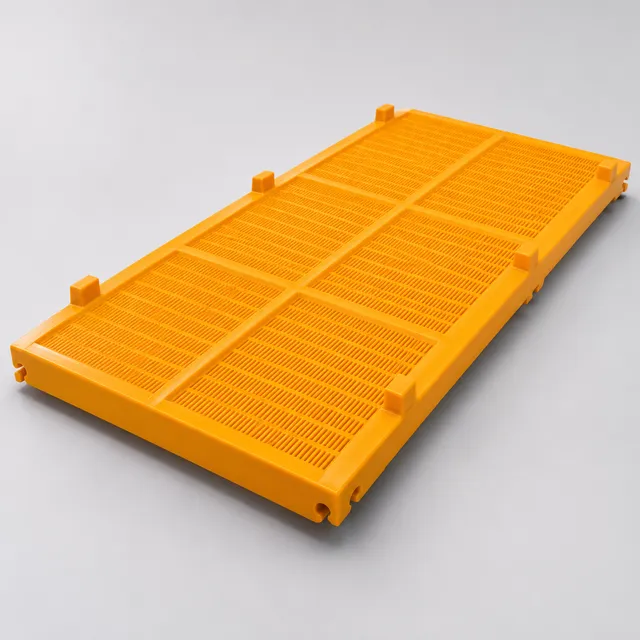
Polyurethane Dewatering Panels
Fine-slot PU panels for dewatering screens on sand, coal and mineral plants.
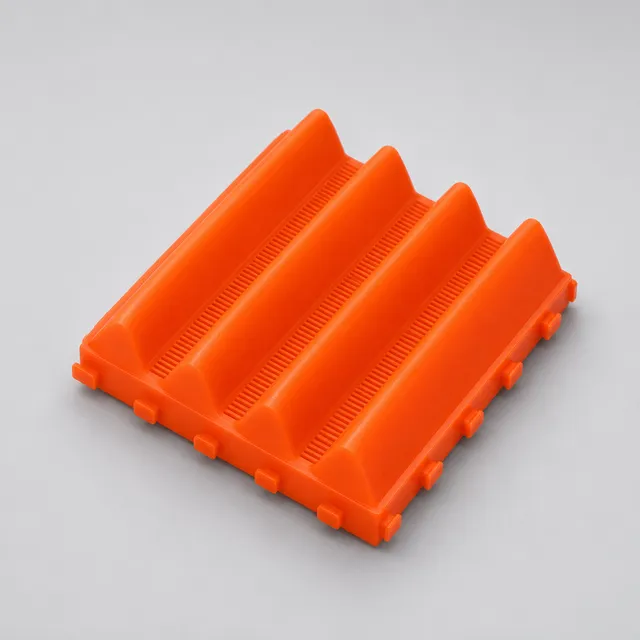
Hump (Raised-Ridge) Dewatering Panels
3D ridged surface with roughly half as much again screening area as a flat panel.
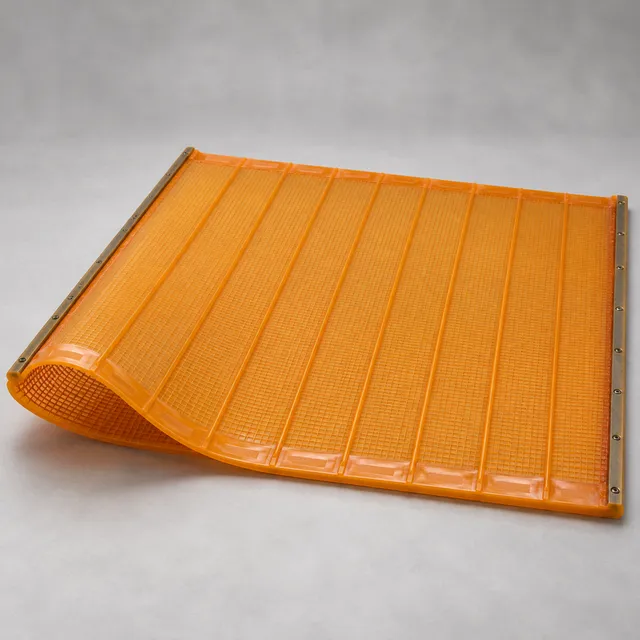
Fine Slot Polyurethane Panels
Precision-moulded fine-aperture panels for classification, desliming and dewatering.
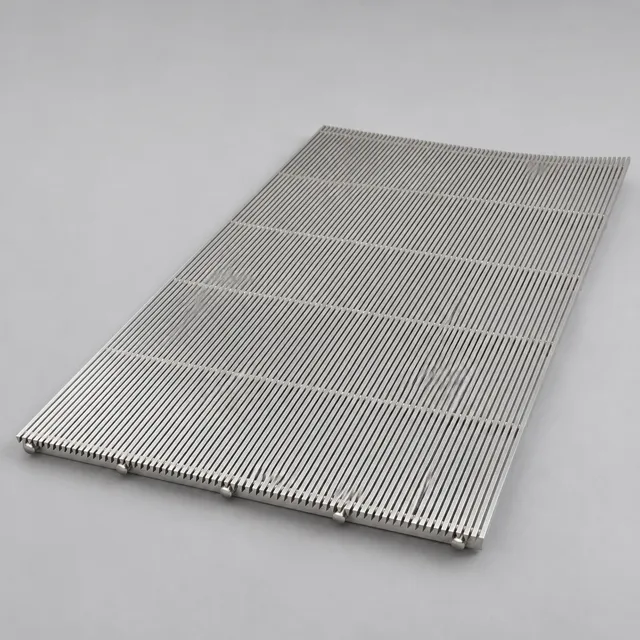
Wedge Wire Panels & Sieve Bends
V-profile wire welded to support rods: flat panels, curved sieve bends and slotted deck sections.
Need a replacement screen?
Send the sizes and a photo of the old panel. We reply with a quotation or questions.
More guides
Screen Blinding vs Pegging: Causes and Fixes
Blinding is a coating of sticky fines that covers wires and closes many apertures; pegging is individual near-size or elongated particles wedged in…
Measure & orderSlotted Screen Openings: With-Flow vs Across-Flow
With-flow slots place the long opening parallel to material travel and generally favour capacity and release of sticky feed. Across-flow slots place…
Measure & orderHow to Measure Modular Polyurethane Screen Panels
Measure a modular polyurethane panel only after identifying its fixing system. Record the finished footprint, thickness and build height; then…